
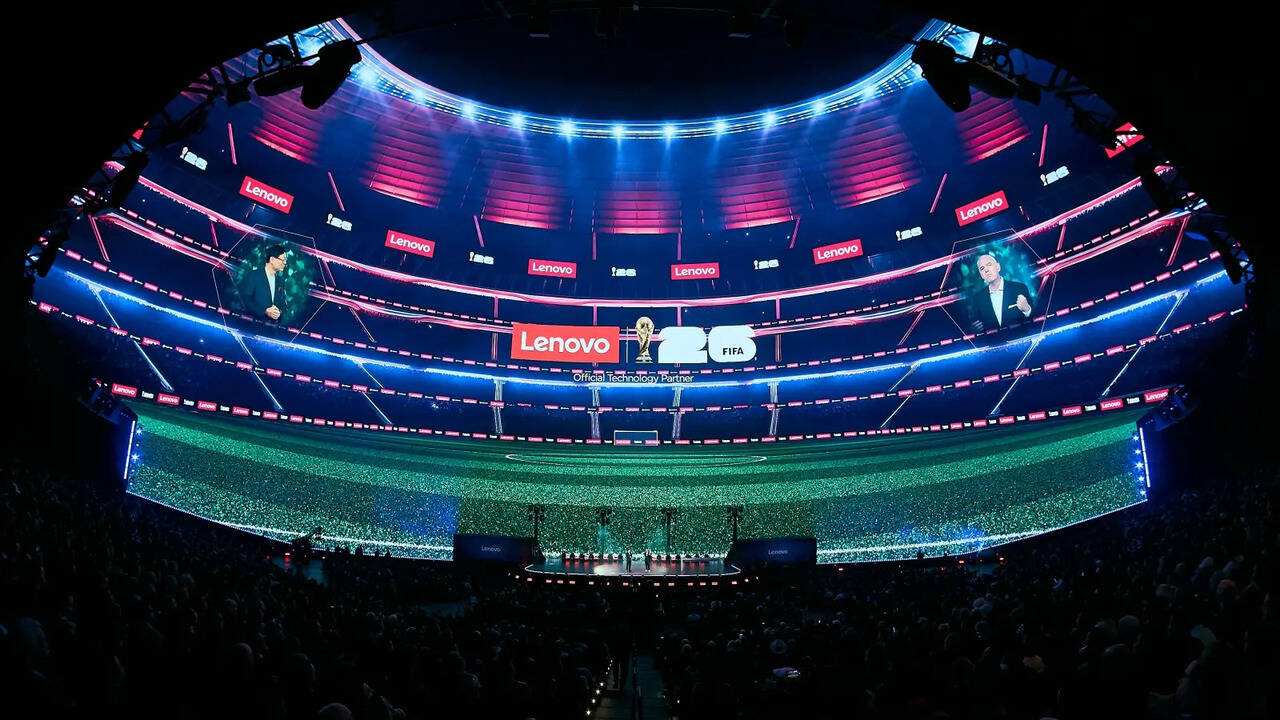
We are almost a week away from the biggest sporting event in the world – the FIFA World Cup 2026. And, while the fans await, the beautiful game is undergoing a structural rewiring. Just like other sports, football has always relied on human intuition, paper-thin tactical margins and the naked eye of the referee (and his assistants).
But next week, when the FIFA World Cup 2026 kicks off across North America, the tournament will not just be the largest sporting event in human history — it will serve as the commercial launchpad for a new era of sports science.
Through an expansive, multi-layered technological partnership, FIFA and Lenovo are injecting Artificial Intelligence directly into the pitch, the coaching box, the referee’s kit and the infrastructure powering 104 matches across three nations. A few months ago, Times Now visited the FIFA Headquarters in Zurich and got a first hand experience of these technologies that will power this year’s event.
FIFA President Gianni Infantino and Lenovo Chairman and CEO Yuanqing Yang made clear, the imminent tournament is merely the opening whistle. The systems being deployed are designed to fundamentally democratise elite-level athletics, leveling the tactical playing field for underdog nations while preparing a multi-billion-dollar framework for consumer-facing sports intelligence.
The Equalizer: Football AI Pro
The centerpack of this technological shift is Football AI Pro, a specialised enterprise knowledge assistant co-developed by FIFA and Lenovo. Built atop Lenovo’s proprietary AI Factory, the tool behaves like an autonomous team of tactical analysts.
Football is an incredibly data-rich environment, capturing petabytes of information across tracking matrices, player performance histories, team rosters, and historical match archives. The sheer volume makes manual data mining an impossibility for smaller nations without massive technical staffs.
Football AI Pro resolves this bottleneck by orchestrating multiple intelligent agents to search, filter and analyze over 2,000 distinct metrics in real time.
The system operates across three distinct tiers to alter pre-match preparation:
For Analysts: It instantly aggregates team patterns, translating raw data into side-by-side video clips and physics-accurate 3D avatars.
For Coaches: It acts as a data-validated tactical sandbox. A coach can input a prospective mid-game formation change, and the AI will calculate the statistical probability of success against their upcoming opponent’s historical defensive habits.
For Players: It generates highly personalised, context-aware match overviews directly to their devices, detailing specific visual breakdowns of the opposing players they will face in their specific zones.
Critically, this tool is being deployed as a universal utility. The 2026 tournament features an expanded field containing historic tournament debutantes, including two of the smallest nations to ever qualify: Curaçao and Cabo Verde.
By delivering Football AI Pro to every single competing association, FIFA is actively attempting to strip away the analytical advantages historically hoarded by wealthy footballing superpowers.
Re-Engineering the Offside
FIFA is also bringing AI directly to the line of officiating. The tournament will see deep integration of Digital Avatars into Advanced Semi-Automated Offside Technology. Engineered alongside FIFA’s VAR technology provider, Hawk-Eye Innovations, this system moves past generic digital mannequins. Using advanced generative AI and precise 3D assets, Lenovo and FIFA are creating exact digital twins of the tournament’s players, meticulously mapping individual physical dimensions, skeletal proportions and unique body physiques.
When a potential offside incident occurs, the system utilizes these highly accurate avatars within automated 3D rendering sequences. This provides match officials with an unprecedented level of geometric precision during reviews, effectively eliminating the margin of error caused by clothing or generic player models.
For the viewing public, these animations will be fed directly into stadium screens and global broadcasts, offering immediate visual transparency to an anticipated six billion viewers worldwide. T
The Logistics of an Expanded Continent
With 48 teams playing 104 matches across Canada, Mexico and the United States, the scale of the 2026 tournament creates massive logistical friction. To navigate this, FIFA is deploying an Intelligent Command Center powered by Lenovo’s enterprise hybrid architecture.
The command infrastructure runs real-time digital twins of every tournament venue, paired with AI-driven predictive modeling. The system continuously tracks operational flows, stadium foot traffic, supply chains and safety trends across the continental footprint, providing officials with automated daily summaries and real-time intervention recommendations.
Broadcasts from the Inside Out: AI Ref Cam
In tandem with structural operations, the fan experience is being repositioned to place the audience inside the action. Lenovo and FIFA have confirmed the wide-scale deployment of Referee View body cameras for the tournament.
While raw referee cameras have been trialed previously, footage was historically plagued by rapid human motion, erratic head tilts and heavy visual distortion. To correct this, Lenovo is implementing an AI-driven stabilisation overlay.
The software cleans and balances the live feed in real time, transforming shaky, unwatchable video into cinema-grade broadcast streams. Audiences will see players interacting with officials, visual angles during critical penalty decisions and the high-velocity pacing of elite play right from the center of the pitch.
The Long Game
As the teams take the field next week, the narrative will inevitably focus on goals, trophies and human drama. But beneath the grass, the digital infrastructure of football is shifting permanently.
By combining the analytical power of multi-agent factories, custom generative avatars and stabilized first-person broadcasts, FIFA and Lenovo are laying down an architectural foundation. What begins next week as an elite operational system for a World Cup will eventually trickle down to regional leagues, youth academies and personal mobile screens.
