
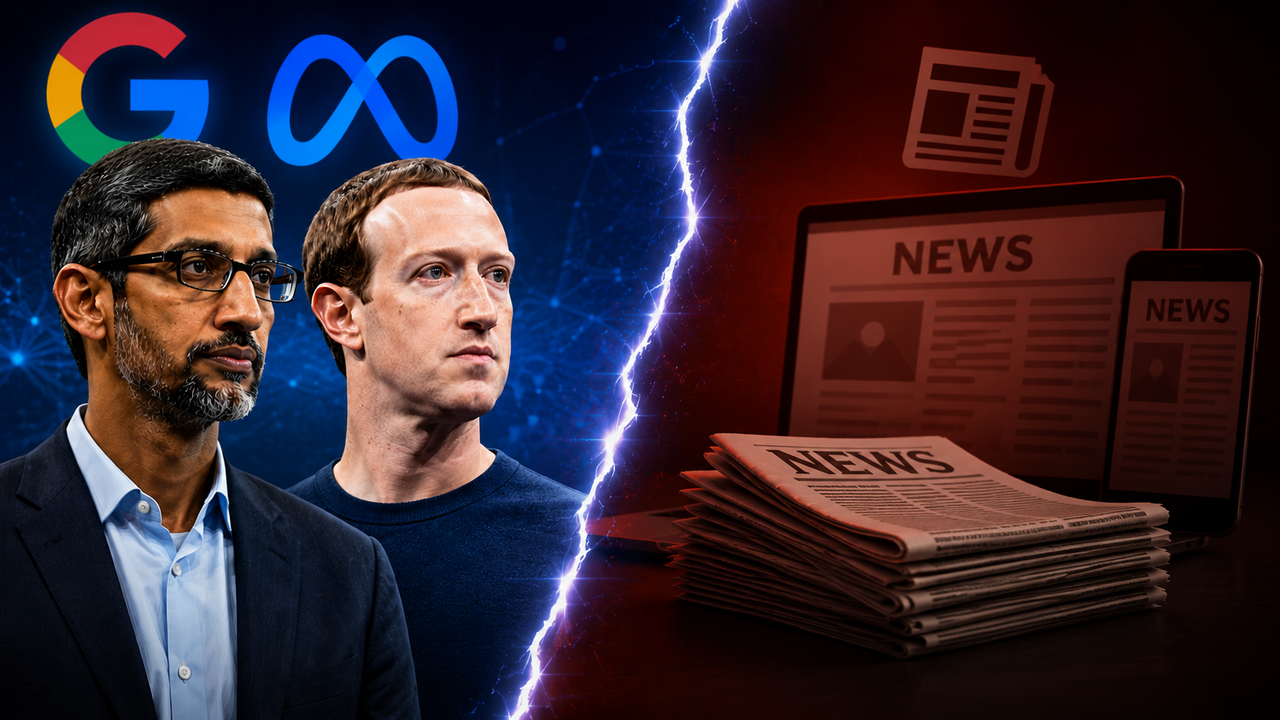
The ongoing dispute between big tech and news publishers is likely to enter a new phase, where artificial intelligence-based Google Search could fundamentally change how news is consumed and monetised. As AI-led search tools offer instant summaries of news articles, publishers have a huge concerning question: Will readers stop visiting original content sites altogether and face huge revenue losses?
Notably, the concern is not just about AI systems trained on copyrighted content. Publishers suggest that AI-generated summaries can harm original content itself and keep users inside big tech ecosystems while bypassing the websites that produced the reporting.
Timesnownews.com spoke with experts to understand how AI-powered search is fundamentally altering the economic foundations of news publishing.
‘Readers May Stop Visiting Original Articles’
Prabhu Ram, VP-Industry Research Group at CMR, said, “AI-powered search is fundamentally altering the traffic dynamics that have sustained digital news publishers, shifting the model from content discovery to direct in-platform consumption.”
He believes that the bigger challenge lies with how the revenue is distributed. “The core challenge is economic: platforms capture greater engagement while publishers risk losing monetisation opportunities,” he added.
Moreover, at the same time, India’s legal and regulatory frameworks are yet to fully address the rise of generative AI.
Legal experts have highlighted how publishers may increasingly challenge AI summaries as forms of “content substitution” rather than simple content discovery.
Debate Over Compensation And Copyright
Tech lawyer and AI governance expert Shweta Bansal said publishers could argue that AI-generated answers effectively replace the need for readers to access original articles.
“Yes, publishers can make that argument,” Bansal said. “Under the Copyright Act, the owner has exclusive rights to reproduce and communicate the work to the public, and unauthorised copying can infringe copyright,” she added.
Bansal explained that if an AI summary captures the essence and core informational value of a report, publishers may argue it undermines the original work commercially. She asserted, “An AI summary that replaces the need to click through and read the original article can be framed as a substitute rather than mere discovery, especially if it reproduces enough protected expression or captures the article’s core value.”
Cyber law expert and Supreme Court advocate Pavan Duggal described AI summaries as a major reason why news publishers may suffer. “The ultimate idea is that you just read the summary, you do not go to the original article,” Duggal said.
According to Duggal, this directly impacts the revenue models that sustain journalism.
“That effectively means that the big potential revenues that were to be accruable to content creators or media houses who have created the original news are going to be bypassed,” he said.
Duggal added, “I expect a series of litigations being launched in different jurisdictions, challenging these actions and ultimately seeking a declaration of the real law from the court.”
At the centre of the conflict is a larger question confronting the global media industry: if AI systems become the primary gateway to information, who ultimately benefits from journalism?
For years, publishers accepted a platform-driven internet because search engines and social media still redirected audiences back to news websites. AI-generated summaries threaten to alter that equation by keeping users inside closed ecosystems where platforms retain attention, engagement, and advertising opportunities.
Several media organisations have raised concerns that big tech companies are using their content to train AI systems without paying them. However, India currently does not have laws that require tech platforms to compensate publishers for using their content, unlike countries such as Australia and Spain, which have proposed or introduced revenue-sharing rules.
Earlier this year, Union Information and Broadcasting Minister Ashwini Vaishnaw said social media and digital platforms should ensure fair revenue sharing with those who create content, including media organisations, journalists, researchers, and independent creators.
Related News |
Big Tech vs Publishers: AI Summaries Or Content Theft? Expert Explains
His remarks indicate that India is beginning to recognise the issue at a policy level. However, there is still no clear legal framework that holds big tech companies accountable for using publishers’ original content in AI systems.
As AI increasingly changes how people consume news online, the conflict between big tech platforms and publishers is becoming one of the biggest challenges facing the future of journalism. For publishers, the concern goes beyond losing website traffic. The bigger fear is whether original reporting can remain financially sustainable in an internet increasingly dominated by AI-generated answers.
