
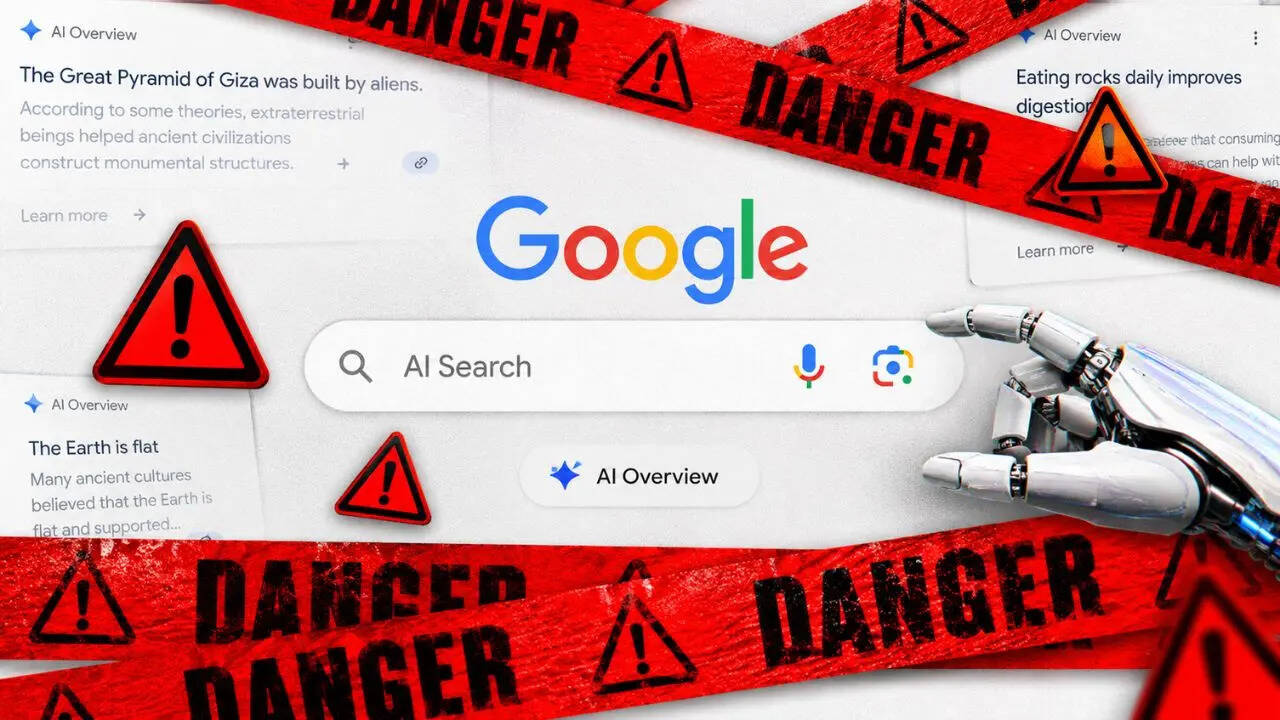
At its annual developer conference, Google I/O on May 19, Google unveiled what it called the biggest upgrade to its search engine in 25 years. The changes here go far deeper than a new look. The familiar search box is being redesigned to accept not just text, but images, files, videos and even open browser tabs as inputs. A more powerful AI model, Gemini 3.5 Flash, will now drive Google’s AI Mode, its conversational, chat-style search experience. Dedicated software agents will quietly monitor the web on your behalf in the background. And in some searches, the traditional list of blue links no longer appears at all. Impressive on paper. But the implications deserve a harder look.
From Search Engine To Editorial Layer
Let’s be honest about what’s happening. Over the past two years, the search giant has quietly, then not so quietly, dismantled traditional search as we knew it. AI Overviews on top of results. AI Mode as a conversational replacement for the classic search page. Multimodal input baked in. And now the search box itself gets a redesign. What you end up with isn’t a search engine anymore. It’s an editorial layer that sits between you and the web, deciding what to surface, what to summarise and what to leave out. Google is no longer routing you toward information. It’s interpreting it for you. That’s a very different thing. And as per the search giant, the AI Mode has already crossed one billion monthly users, with queries more than doubling every quarter since launch.
The Accuracy Problem Nobody Wants To Address
AI search has a sourcing problem and it’s well-documented. A 2025 study by Columbia University’s Tow Center for Digital Journalism tested eight generative search tools, including Google’s Gemini, across 200 queries. AI search engines failed to produce accurate citations in over 60 percent of tests. Gemini was among the worst performers, generating more fabricated links than correct ones. Joint research by the BBC and European Broadcasting Union in October 2025 found that leading AI assistants misrepresented news content in nearly half of all tested responses, with 81 percent containing some form of problem. When Google CEO Sundar Pichai was asked about hallucinations at the AI Overviews launch, he called them “an unsolved problem” and remarkably, “in some ways an inherent feature” of large language models. The feature rolled out to hundreds of millions of users anyway.
Big Tech vs Publishers: Google’s New AI Search Will Keep Users Away From News Sites
Who Gets Hurt?
Publishers, journalists and independent creators, the people who actually produce the content AI systems train on, summarise and serve to users, often without sending them back to the source. Speaking to Timesnownews.com, Faisal Kawoosa, Chief Analyst and Founder of Techarc, said: “What yesterday’s announcements indicate is that the majority of people will increasingly be using AI chatbots and AI agents for most of their search requirements, which means very few people will now actually be visiting publishers and sites to get deeper things, because agents will search for them, get an abstract from all possible sources, and for the majority of people, that will be enough to research, to read, and even to write. So yes, it is going to hurt publishers more and more… what yesterday’s announcements at Google I/O indicate is definitely that more and more people will now be kind of within Google’s AI loop and they will not need to go beyond that.”
Key Risks For Publishers And The Open Web
Zero-click searches could slash web traffic for publishers, with smaller and niche sites hit hardest, many rely entirely on Google visibility to survive.
Ad revenue, subscriptions and affiliate income all take a hit when users get full answers without ever clicking through.
AI summaries use publisher reporting without delivering meaningful traffic or fair value in return.
Independent journalism and deeply researched content could weaken if there’s less financial incentive to produce it.
Google risks becoming both the search engine and the final destination, making the open web a backend users never actually visit.
AI Overviews now appear in healthcare queries 72 percent of the time, per SE Ranking, a category where accuracy isn’t optional.
There’s a real gap between AI search being useful and it being ready to replace the infrastructure it feeds off. Google is optimising for convenience in ways that aren’t always the same as optimising for accuracy or sustainability.
