
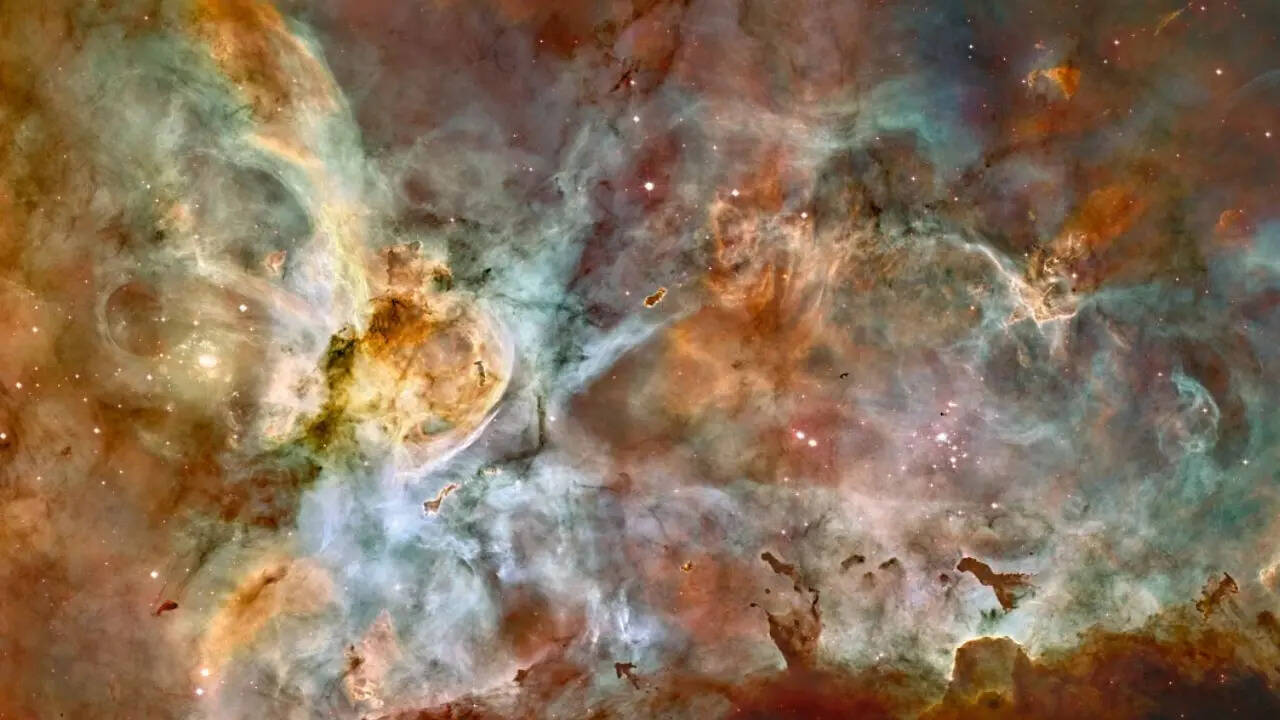
With the help of the Hubble Space Telescope, we can now see the most beautiful pictures and patterns present in space that cannot be seen with the human eye. These images also help astronomers study the various patterns and activities happening in outer space.
Beautiful Pictures by the Hubble Space Telescope
Here are some of the most interesting images taken by the Hubble Space Telescope. This telescope is equipped to capture various visuals from different angles which are more than 8000 light km away from us.
The Bubble Nebula
This picture is of a Bubble Nebula, which is also known as NGC 7635. It is an emission nebula, which is located almost 8000 light-years away. This image was captured with the help of the NASA/ESA Hubble Space Telescope; without that, it won’t be visible to human eyes. It also celebrated its 26th year anniversary in space. (Credit: NASA, ESA, Hubble Heritage Team)
New view of the Pillars of Creation — visible
This is an Eagle Nebula’s Pillars of Creation. It shows the pillars which are visible in light and captured with the multicoloured glow of gas clouds, wispy tendrils of dark cosmic dust, and the rust-coloured elephants’ trunks of the nebula’s famous pillars. These pillars are the intense radiation from young stars. (Credit: NASA, ESA/Hubble and the Hubble Heritage Team)
The Stellar Forge
In this picture we see an orange glow which originates from the centre of NGC 1792 and is also the heart of the stellar forge. This view gives us some idea about the galactic powerhouse. It shows the vast swathes of tell-tale blue which are seen through the which indicates the area which is full of young and hot stars. (Credit: ESA/Hubble & NASA, J. Lee, Acknowledgement: Leo Shatz)
Light and shadow in the Carina Nebula
This is a complex structure within the Carina Nebula which is revealed by the ‘Keyhole Nebula’. In this picture we see a montage assembled from the four different telescopes in April 1999. The circular feature which is part of the Keyhole Nebula was named in the 19th century by Sir John Herschel. This region is almost 8000 light-years from Earth. (Credit: NASA/ESA, The Hubble Heritage Team (AURA/STScI)
The Red Spider Nebula
This image shows huge waves which are sculpted in a two-lobed nebula which is 3000 light-years away in the constellation of Sagittarius. It is a warm planetary nebula which is the hottest star and is known for its powerful stellar winds that generate waves 100 billion kilometres high. These waves are caused by the supersonic shocks which form a local gas. (Credit: ESA & Garrelt Mellema (Leiden University, the Netherlands)
Star birth in the extreme
This is the view of the Carina Nebula, which shows a star birth in detail. This nebula is sculpted by the action of outflowing winds and scorching ultraviolet radiation from the monster stars that inhabit this inferno. In this process the stats shred the material in the last vestige of the giant cloud. (Credit: NASA, ESA, N. Smith (University of California, Berkeley), and The Hubble Heritage Team (STScI/AURA)
Light continues to echo three years after stellar outburst
This image captured by the Hubble Space Telescope is the latest image of the V838 Monocerotis, also known as V838 Mon. This revealed dramatic changes in the illumination of surrounding dusty cloud structures. This effect is called the light echo that has been unveiling never-before-seen dust patterns. (Credit: NASA, ESA, and The Hubble Heritage Team (AURA/STScI)
