
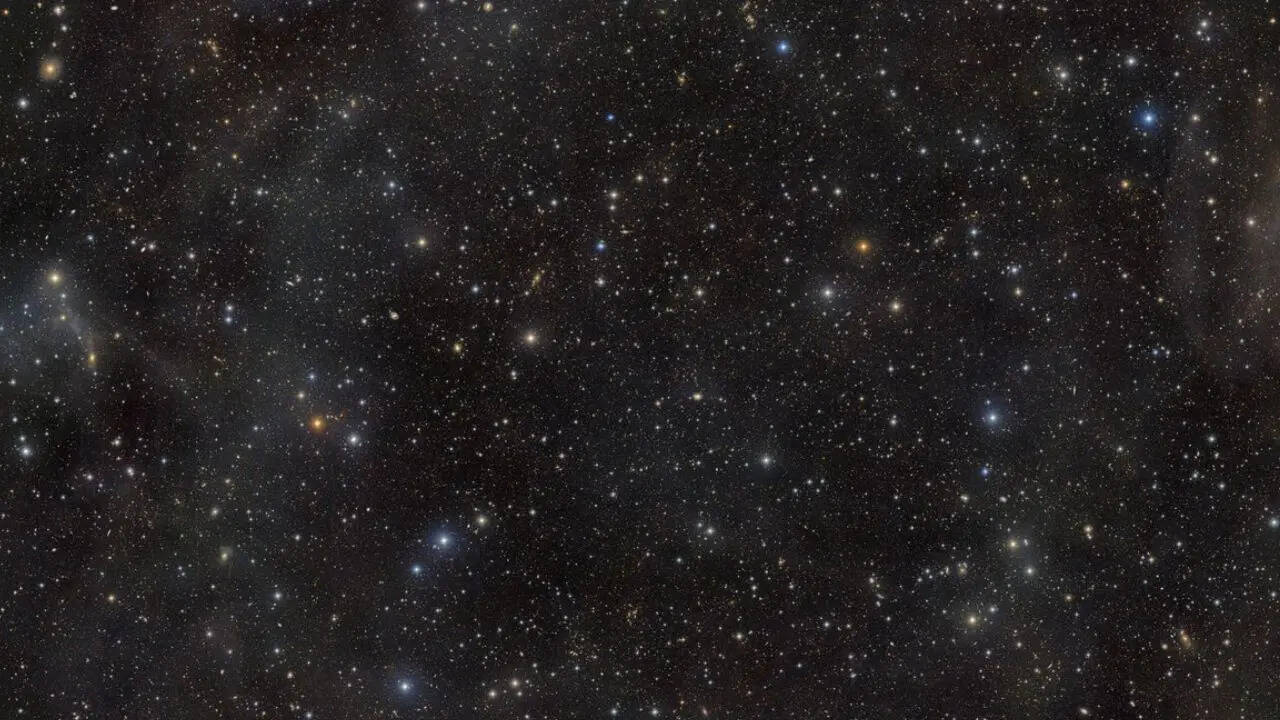
It is not every day that astronomers release an image that makes even seasoned space enthusiasts pause. This time, researchers at the Vera C. Rubin Observatory have done exactly that, unveiling a breathtaking cosmic view packed with more than 500,000 galaxies and over 50,000 stars in a single image. Captured using the world’s largest digital camera, the photograph offers an astonishingly detailed look into one of the most closely observed regions of the universe.
Hundreds Of Photos Combined Into One Extraordinary View
Despite how seamless the final image looks, it wasn’t captured with a single click. Instead, astronomers stitched together hundreds of separate exposures taken by Rubin Observatory’s 3.2-billion-pixel LSST Camera, allowing incredibly faint objects to slowly emerge from the darkness.
Look closely and you’ll find a universe buzzing with activity. Elegant spiral galaxies stretch across the frame, massive elliptical galaxies glow softly, while others appear caught in the middle of cosmic collisions. Scattered between them are only a handful of bright stars from our own Milky Way, making the distant galaxies stand out even more dramatically.
The Vera C. Rubin Observatory is a collaborative project funded by the US National Science Foundation and the US Department of Energy’s Office of Science, and this image offers an early glimpse of what the observatory is expected to deliver over the coming years.
Why Astronomers Keep Looking At This Part Of Space
The image focuses on the COSMOS field, a relatively small patch of sky that has become one of astronomy’s favourite research targets. Scientists have been returning to this region ever since the Hubble Space Telescope first studied it in 2003 because it provides an unusually clear view of the distant universe, free from much of the dust and crowded stars found elsewhere in our galaxy.
That clear window into deep space also doubles as a window into the past. Since light from the most distant galaxies has spent billions of years travelling toward Earth, every observation reveals another chapter of cosmic history.
The newly released image forms part of Rubin Observatory’s Early Data Preview 2 (EDP2), bringing together observations collected between April 2025 and January 2026 across nearly 3,000 square degrees of the southern sky. It marks only the beginning of a decade-long survey that scientists hope will transform our understanding of how the universe changes over time.
