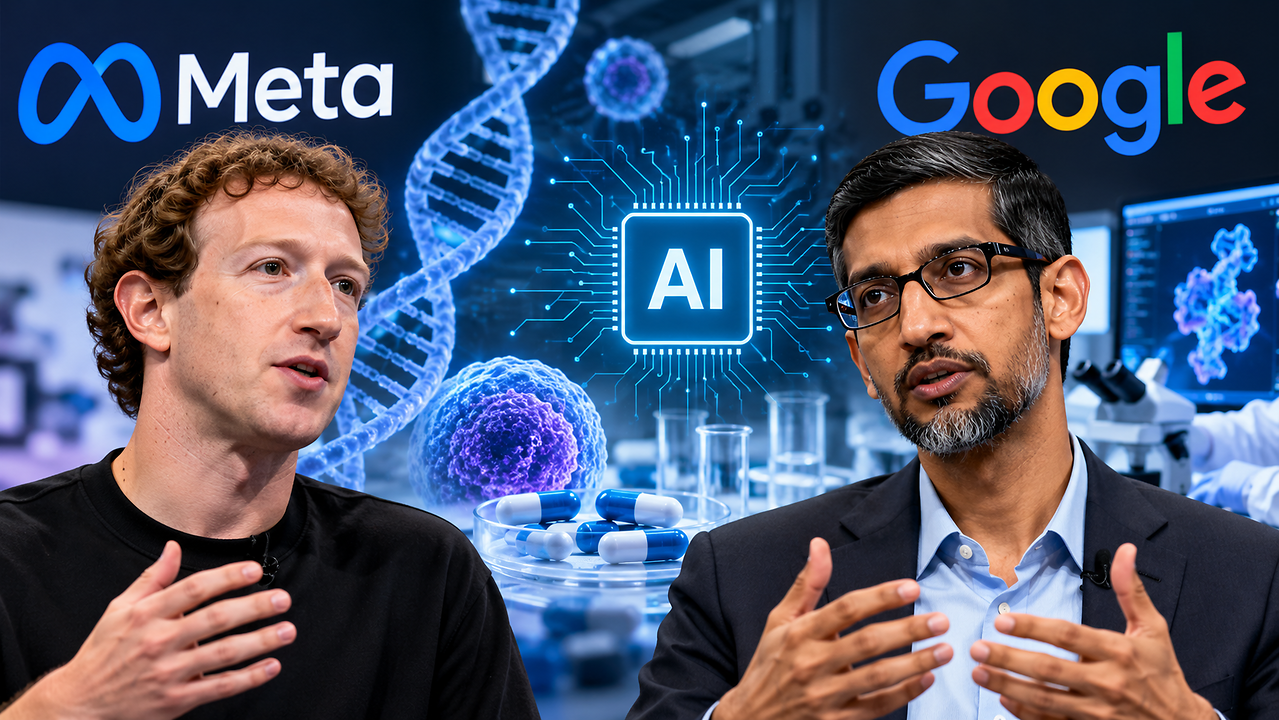
AI is now moving beyond chatbots, image generation and coding. Big tech companies are looking at how it can be used in science and healthcare. Now, according to a new report, Meta and Google are joining a major effort to build AI models that can understand biology and help speed up drug discovery.
According to Reuters, Meta, Google DeepMind and drug discovery company Isomorphic Labs are together investing $300 million in a new effort led by nonprofit organisation Biohub.
The project now has a total investment of around $1.8 billion, with funding also coming from the US government.
The project is called the Virtual Biology Initiative. Its main aim is to create large datasets that can be used to train AI models to understand how cells behave under different conditions.
Scientists can then use these models to predict how cells may respond to different changes, which may eventually help in developing new medicines faster.
The US Department of Energy is also investing more than $500 million over five years in laboratory measurements, modelling and computing.
The National Institutes of Health will also coordinate datasets created through more than $500 million in earlier federal funding. Biohub plans to standardise this data so it can be used for AI training.
Reuters reported that the project will collect data using technologies such as spatial transcriptomics, which can show molecular activity inside tissue, along with other methods that record how cells react to changes in their environment.
One of the biggest challenges is the amount of data required. Existing cell datasets contain hundreds of millions of cells, but Biohub believes AI models may eventually need data from billions or even trillions of cells to make accurate predictions.
The idea is to complete work that could normally take decades in around five years. Biohub expects its first major dataset to be ready within about a year.
The datasets will eventually be made public. However, companies funding the project may get early access to some of the data before it is released publicly.
The move also shows how major AI companies are expanding into biological research. Anthropic is also working on biology research, while the OpenAI Foundation has launched a more than $125 million programme to support biological and medical datasets for AI research.
(with inputs from Reuters)