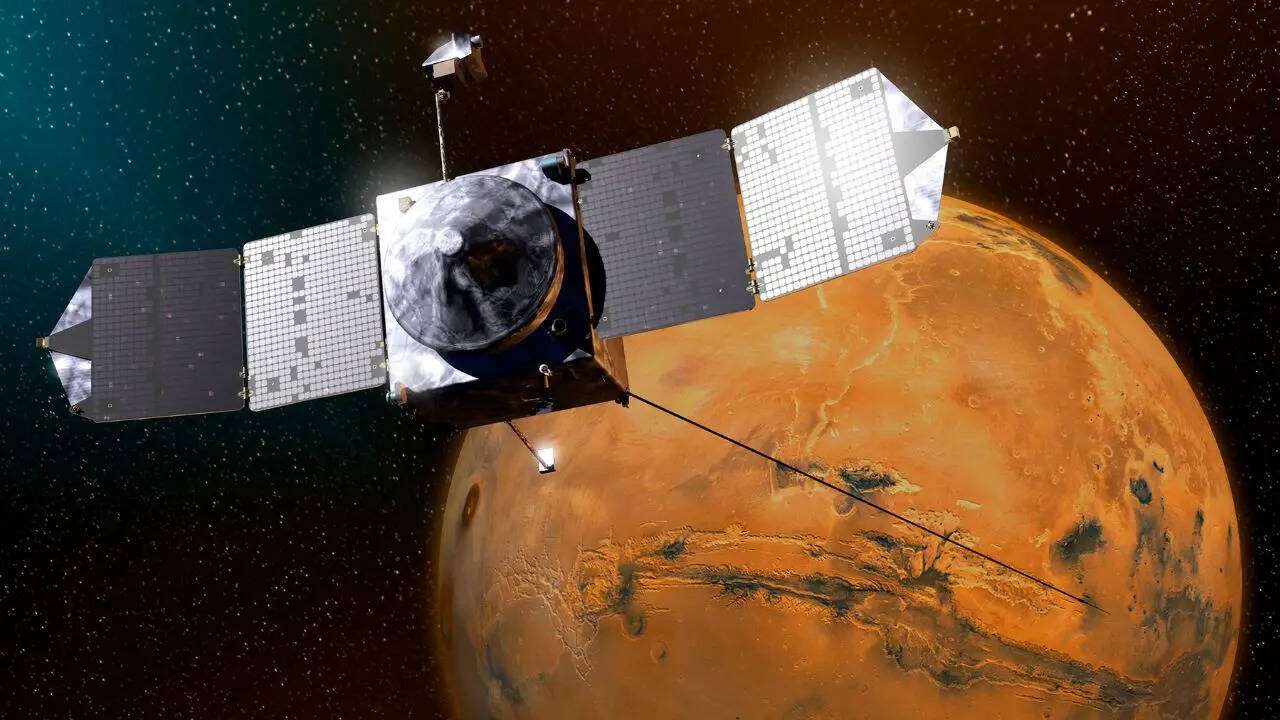
After spending more than a decade helping scientists unlock the secrets of Mars, NASA’s MAVEN spacecraft has reached the end of its journey. The American space agency has officially declared the Mars orbiter dead after losing contact with the spacecraft nearly six months ago. The mission, which was never expected to last this long, played a major role in helping researchers understand how Mars transformed from a potentially habitable world into the cold and dry planet we see today.
What Happened To MAVEN?
The trouble began in December last year when MAVEN disappeared behind Mars and never re-established normal communication with Earth. According to NASA, data suggested the spacecraft entered a rapid spin. That unexpected movement disrupted its orbit and eventually drained its onboard batteries, leaving the probe unable to recover.
Following months of analysis, a NASA review board concluded that the spacecraft could no longer be restored to operation. While investigators are still trying to determine the exact cause of the anomaly, the mission itself has now officially come to an end.
A Mission That Outlived Expectations
MAVEN, short for Mars Atmosphere and Volatile Evolution, launched aboard a United Launch Alliance Atlas V rocket in November 2013 and arrived at Mars roughly 10 months later. The spacecraft was originally designed for a mission lasting just one Earth year. Instead, it continued operating successfully for more than a decade.
During that time, MAVEN became the first orbiter specifically equipped to study how the Martian atmosphere interacts with the solar wind. Its observations helped scientists better understand how Mars gradually lost much of its atmosphere over billions of years.
MAVEN also served as a critical communications relay between Earth and NASA’s Curiosity and Perseverance rovers exploring the Martian surface.
Last year, MAVEN helped scientists observe comet 3I/ATLAS as it passed through the Solar System. Using specialised ultraviolet instruments, the orbiter captured valuable data that researchers continue to analyse.
MAVEN’s lead scientist, Shannon Curry from the University of Colorado Boulder, reflected on the mission’s impact, saying the spacecraft made a number of “amazing discoveries.”
She added that MAVEN “has truly advanced our understanding of the Martian atmosphere and evolution.”
“The data collected from MAVEN will continue to provide valuable insight into Mars for decades to come,” said Louise Prockter, director of NASA’s Planetary Science Division.
With MAVEN now retired, NASA is left with two active Mars orbiters: Mars Odyssey and the Mars Reconnaissance Orbiter, both of which have already far exceeded their original mission lifetimes.